
How to Monitor Your Renovation Budget: Avoid Hidden Costs
How to Monitor Remodeling Progress with Inspections
Monitoring your remodeling project with inspections ensures that work meets safety codes, avoids costly mistakes, and keeps your timeline on track. Key takeaways include:
- Why Inspections Matter: Catch issues early (e.g., poor wiring, structural flaws) to prevent expensive fixes. Rework costs can reach 5–10x the original budget.
- Inspection Milestones: Plan for key phases like pre-demolition, rough-ins (plumbing, electrical), mid-project reviews, and final walkthroughs.
- Payment Tied to Progress: Link contractor payments to inspection milestones to maintain accountability.
- Documentation: Take photos, use checklists, and track changes to stay organized and ensure compliance.
- Licensed Professionals: Always hire licensed contractors and inspectors to avoid conflicts of interest.
Inspections are your safeguard for quality, safety, and budget control throughout the remodeling process.
Planning Your Inspection Strategy
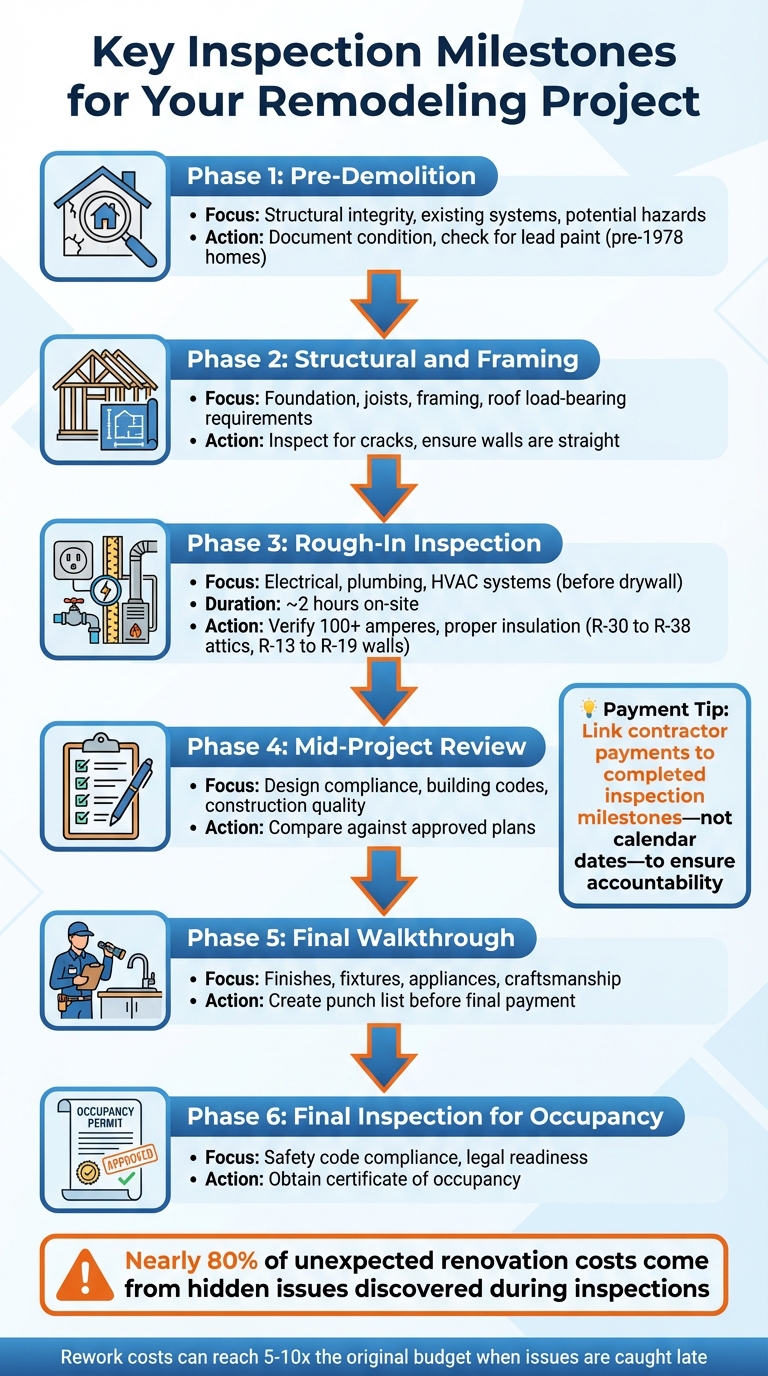
Remodeling Inspection Milestones and Timeline Guide
Creating a solid inspection plan is essential to avoid costly mistakes during your construction or remodeling project. Start by organizing your timeline and clearly assigning roles. Tie your payment schedule to inspection milestones, such as pouring the concrete slab or completing the roof dry-in, to safeguard your investment and ensure accountability. As Randall A. Cantrell from the University of Florida IFAS emphasizes:
A substantial final payment, payable only after the certificate of occupancy (if applicable) has been issued and all corrective work has been completed, can encourage the contractor to complete the project to the owner's satisfaction.
Put everything in writing before the work begins. Define what counts as "completed", set limits for failed inspections, and outline notice periods for scheduling inspections. This approach naturally leads to establishing specific milestones.
Setting Inspection Milestones
Inspection milestones should follow the logical phases of construction:
- Pre-Demolition: Assess the structure, existing systems, and any potential hazards.
- Structural and Framing: Examine the foundation, joists, framing, and roof to ensure they meet load-bearing requirements.
- Rough-In Inspection: Check electrical, plumbing, and HVAC systems before drywall installation. This typically takes about two hours on-site.
- Mid-Project Review: Confirm compliance with design specifications and building codes.
- Final Walkthrough: Inspect finishes, fixtures, and appliances while compiling a punch list before issuing the final payment.
- Final Inspection for Occupancy: Verify safety code compliance and legal readiness for use.
| Remodeling Stage | Inspection Focus Areas |
|---|---|
| Pre-Demolition | Structural integrity, existing systems, potential hazards |
| Rough-In | Electrical, plumbing, HVAC, and other mechanical systems |
| Mid-Project | Design alignment, construction quality, permit compliance |
| Final Walkthrough | Finishes, fixtures, appliances, and craftsmanship |
Defining Roles and Responsibilities
Your contract should assign responsibility for scheduling inspections to the general contractor. It should also require licensed professionals to inspect technical components like electrical, plumbing, and HVAC systems.
Hiring licensed home inspectors ensures unbiased evaluations. Contractors inspecting their own work can lead to conflicts of interest. As Build Strong Group warns:
If a contractor inspects the property and later offers to complete the repairs, there's a chance they could inflate problems or downplay others to get work. That's a conflict of interest.
Always verify your contractor’s license through Florida’s DBPR. Include notice periods so you can attend inspections, ask questions, and get a clear understanding of any technical issues. Be prepared for per-visit inspection fees and potential delays if problems are found. These steps are vital to keeping your project on track and maintaining high standards.
In Orlando and Central Florida, Gomez Contractors exemplifies this approach with their focus on rigorous inspections, effective communication, and structured scheduling to ensure top-tier remodeling outcomes.
sbb-itb-8935015
Building Inspection Checklists
Detailed checklists are the backbone of a successful remodeling project. They help ensure every phase aligns with quality and safety standards while minimizing costly mistakes. By organizing checklists by project phase and room, you can avoid overlooking critical details. A typical remodeling process follows these phases: Planning/Design, Demolition, Framing, Mechanicals (Rough-in), Walls/Drywall, Flooring, Cabinets, Appliances, and Final Touches.
Documenting Inspection Results
Take photos at every inspection stage, especially before mechanical systems are covered by walls. As noted by BiggerPockets:
Having your building inspected regularly throughout construction can prevent major issues. If an inspector catches an electrical mistake your crew just made, it can be easy to remedy. But if the mistake isn't caught until you've installed the drywall, it could be a more costly fix.
Whether you’re tackling a DIY remodel or working with professionals, partnering with experienced experts like Gomez Contractors can offer added peace of mind.
Conducting Inspections During Each Remodeling Stage
During the demolition phase, conduct daily inspections. As Marwood Construction highlights:
Nearly 80% of unexpected costs in a house renovations come from hidden issues like water damage, outdated wiring, or termite infestations.
Eric Jensen, Founder and President of Badeloft USA, emphasizes making sure electrical work is examined before installing drywall.
Stephanie Minasian-Koncewicz from This Old House advises against rushing the final walk-through. At Gomez Contractors, we emphasize thorough inspections throughout every phase.
Using Inspection Findings to Keep Your Project on Track
When inspections reveal defects, act immediately. As Inspectify emphasizes, inspections serve as the backbone of transparency.
| Feature | Early Resolution (During Progress Checks) | Late Resolution (During Punch List/Final) |
|---|---|---|
| Cost Impact | Minimal; often covered by original labor/materials | High; may require tearing out finished work (rework) |
| Schedule Impact | Low; adjustments made during the current phase | High; can delay final occupancy and payment |
| Quality Control | Proactive; ensures "hidden" systems (plumbing/electric) are correct | Reactive; often limited to cosmetic or surface-level fixes |
| Payment Logic | Payments are withheld until specific milestones are met | Final payment is the only leverage remaining |
You can see examples of these high standards in our portfolio of completed projects.
Conclusion
Inspections play a crucial role in protecting your remodeling project. Gomez Contractors handles all inspections as part of their efficient process. Schedule your consultation at Gomez Contractors today.