
Designer-Contractor Partnership Guide
Ultimate Guide to Designer-Contractor Partnerships
When tackling a home renovation, the partnership between your designer and contractor can make or break the project. Designers shape the vision, while contractors bring it to life. Here's what you need to know:
-
Two Models to Choose From:
- Design-Bid-Build: Hire a designer and contractor separately. Offers checks and balances but requires more coordination.
- Design-Build: Combines both roles under one contract for smoother collaboration and faster timelines.
-
Why It Matters:
- Early contractor involvement avoids costly mistakes.
- Strong partnerships keep projects on budget, on schedule, and aligned with your goals.
-
Key Steps for Success:
- Set clear goals, budgets, and communication systems upfront.
- Use tools like spec books and project management software to keep everyone aligned.
- Regular site meetings and clear documentation help resolve issues quickly.
-
Local Considerations for Central Florida:
- Factor in permitting, building codes, and climate challenges.
- Work with licensed professionals familiar with Florida’s requirements.
A well-coordinated team ensures your renovation runs smoothly, avoiding delays and costly surprises.
Roles and Responsibilities
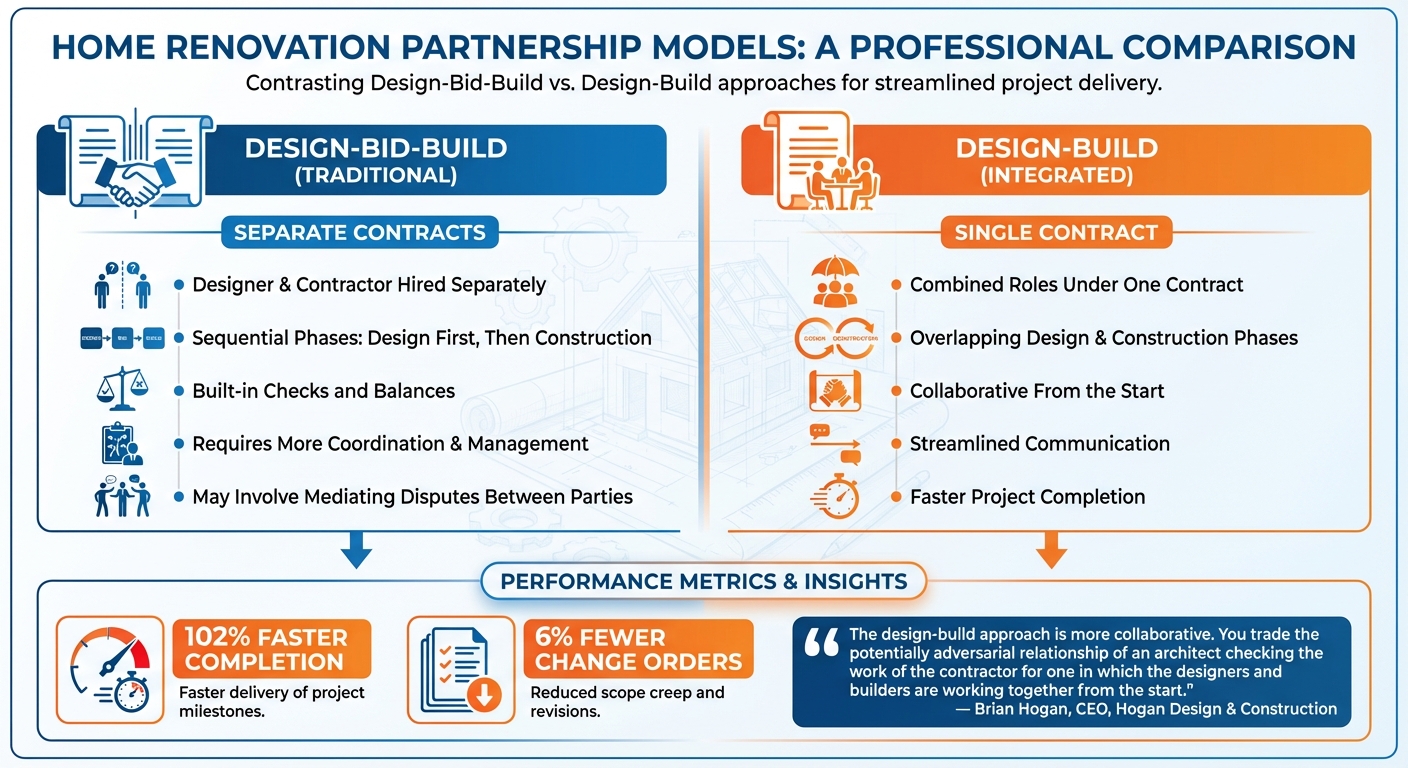
Design-Bid-Build vs Design-Build: Comparison of Home Renovation Partnership Models
What Designers Do
Designers are the creative minds behind a project, shaping everything from the layout of a space to the smallest decorative details. Their work is grounded in technical precision, using tools like floor plans, elevations, ceiling layouts, lighting schemes, and 3D renderings to ensure every aspect of the vision is clear and actionable for construction teams.
A key part of their role is selecting materials and creating a detailed "Spec Book." This document outlines essential information - product specifications, dimensions, colors, and installation instructions - so contractors have a clear roadmap to follow, minimizing potential hiccups during the build.
Designers also serve as the bridge between your aesthetic goals and practical needs. They take your preferences and lifestyle into account, transforming them into home remodeling layouts that not only look great but work seamlessly with how you live. This groundwork sets the stage for contractors to bring the vision to life. Professional teams offer comprehensive remodeling services to manage this transition.
What Contractors Do
Contractors are the hands-on experts who turn design plans into reality. They oversee daily operations on-site, manage subcontractors, source materials, and keep the project on schedule. For larger projects exceeding $15,000, their ability to coordinate these moving parts efficiently is crucial.
Their responsibilities go beyond construction. Contractors assess the structural feasibility of designs, manage material costs, and ensure everything complies with local building codes. This includes obtaining permits, scheduling inspections, and maintaining safety standards on-site.
During the planning phase, contractors play a vital role by providing practical insights. While designers define "what" the project should be, contractors figure out "how" to make it happen - offering feedback on structural integrity, cost considerations, and overall feasibility.
Design-Bid-Build vs. Design-Build Models
The structure of your project can vary depending on whether you choose a design-bid-build or design-build model, each offering its own advantages.
In the traditional design-bid-build approach, designers and contractors are hired under separate contracts. This setup provides a system of checks and balances but requires additional management and may involve mediating disputes between the two parties.
On the other hand, the design-build model consolidates both roles into a single contract. This integrated approach allows design and construction phases to overlap, speeding up timelines. Research shows design-build projects are completed 102% faster and experience 6% fewer change orders.
"The design-build approach is more collaborative. You trade the potentially adversarial relationship of an architect checking the work of the contractor for one in which the designers and builders are working together from the start."
- Brian Hogan, CEO, Hogan Design & Construction
sbb-itb-8935015
Planning for a Successful Partnership
Setting Clear Goals and Priorities
Before construction kicks off, create a detailed scope of work. This document should spell out which rooms are part of the project, the finishes you’re aiming for, and any known limitations like plumbing locations or structural walls. Including measurements and photos can help contractors provide accurate estimates and minimize unexpected issues.
It’s wise to consult at least three contractors to get a sense of market pricing, review common remodeling questions, and ensure they align with your vision. During these consultations, arrange a walkthrough of the space with both your designer and contractor. This gives everyone a chance to assess the site, ask questions, and confirm that the design is practical.
Set up clear communication protocols by assigning a single point of contact - usually the designer - who will provide regular updates. Responsibilities and procedures for handling changes should also be documented in your contracts.
"You have to always stay on top of things and make sure that every little detail is what you wanted. It's difficult to find a good partner that you can trust and with whom you can have good communication." - Ekaterina Groznaya, Interior Designer, Studio E Designs
Both parties should agree in writing on what defines a "completed" project. This prevents misunderstandings about final payments and reduces confusion over callbacks for rework.
Once clear goals and communication systems are in place, the next step is defining your budget and project scope.
Budgeting and Scope Definition
Your budget needs to account for labor, materials, design fees (usually an additional 20%), and a contingency fund of 10–20% for unexpected expenses. Contractors often charge a management fee ranging from 10–20%.
When reviewing bids, don’t just focus on the total cost. Take a closer look at what’s included, especially allowances for fixtures and finishes. A low bid might exclude key items or rely on lower-quality materials. For more complex projects, you might want to hire an independent estimating company to provide a benchmark quote tailored to your location and project type.
"A great contractor might cost more up front, but they save you in the long run. They know where to cut costs without sacrificing quality." - Ryan Saghian, Designer
Structure payments around specific project milestones, like pouring concrete, finishing the roof, or completing drywall, and hold back the final payment until the project passes inspection.
Check that your contractor has an active license through Florida's Department of Business and Professional Regulation (DBPR) and carries workers' compensation insurance. Be aware of Florida's lien law, which allows subcontractors to place a lien on your property if the general contractor doesn’t pay them - even if you’ve paid the contractor in full. To protect yourself, obtain lien waivers for all completed work.
With a solid budget and scope in place, bringing a contractor into the process early can help keep your plans on track.
Why Early Contractor Involvement Matters
Getting a contractor involved during the design phase can save you from investing in plans that are either impractical or too expensive to build. Contractors provide real-time cost estimates as the design takes shape, helping you avoid sticker shock when the final design exceeds your budget.
They also bring valuable knowledge about current material costs, lead times, and supply chain challenges - factors that designers may not always consider. Since many contractors are booked 6 to 12 months (or more) in advance, involving them early ensures your design and construction timelines stay aligned.
"The biggest advantage of working with a design-build firm is that the same team handles both the design and construction. This means your plans are created to be both buildable and aligned with your realistic budget, reducing the risk of investing in a design that can't actually be carried out." - Pete Baughman, Owner and Project Developer, Better Builders
Early collaboration also reduces the need for expensive and time-consuming revisions to fix unworkable designs. For homeowners in Orlando and Central Florida, this step is especially important for navigating local building codes and designing projects that suit the area’s climate and architectural styles.
Communication and Collaboration Practices
At Gomez Contractors, clear and effective communication forms the backbone of every successful project. By fostering consistent routines, designers and contractors stay aligned from start to finish, ensuring a smoother process for all involved.
Establishing Communication Routines
Strong partnerships depend on the "Three Cs of Communication": being Clear (providing written directives), Concise (keeping plans simple), and Consistent (maintaining regular updates). Before the project kicks off, it’s important to establish how everyone prefers to communicate and agree on the frequency of updates.
Scheduling weekly site meetings is a great way to ensure everyone stays on the same page. Document key decisions in meeting minutes, tracking "Action" items (tasks to be completed) and "Pending" items (decisions awaiting materials or approvals). To streamline updates, designate the designer as the main point of contact for relaying design decisions, rather than having the contractor manage this responsibility directly.
A spec book acts as the go-to resource for the project. It consolidates material selections, furniture layouts, dimensions, and installation details, so tradespeople can easily reference it on their own. Including the reasoning behind design choices - such as why a tile pattern must align with a specific sightline - helps ensure the design intent is clearly understood and executed.
Additionally, keeping a project journal to log delivery dates, progress notes, and questions can improve accountability and speed up conflict resolution. Quick morning check-ins with the contractor or foreman can also help address any immediate concerns and clarify priorities for the day.
Once these communication routines are in place, technology can further enhance collaboration.
Using Technology for Collaboration
Digital tools can simplify project communication and keep everyone on the same page. Project management software serves as a central hub, giving designers and contractors access to the same drawings, models, and spec sheets. Real-time version control ensures teams are always working with the most up-to-date blueprints, with automatic notifications alerting them to revisions. Mobile apps also allow field teams to update progress and report issues directly from the job site.
For example, in 2025, Oktra, a design and build firm, saved two hours each week on design coordination by using Autodesk Construction Cloud for cloud-based document management. Similarly, Designer Group cut down the time spent syncing models between the office and the field by 83% through real-time cloud tools.
| Communication Tool | Purpose | Key Benefit |
|---|---|---|
| Project Management Software | Tracks tasks, schedules, and calendars | Ensures everyone stays updated in real time |
| Meeting Minutes | Records decisions from site walks | Maintains a clear history of "Action" and "Pending" items |
Mobile-first, real-time collaboration tools are becoming increasingly popular. When choosing a platform, focus on mobile functionality so contractors can use it easily on-site. Start with basic features like document management before exploring more advanced options.
On-Site Collaboration and Decision-Making
While technology and scheduled updates are essential, on-site collaboration ensures issues are resolved quickly and efficiently. Joint site walks allow teams to assess conditions together and make adjustments in real time. For more complex elements, such as tile patterns or custom millwork, secure physical mock-ups to approve grout colors and finishes under actual on-site lighting before installation begins. This step minimizes the risk of costly rework caused by unexpected variations.
Setting up an on-site message center - a central notebook for daily messages and decision logs - can also help keep everyone informed. To avoid disrupting workflow, schedule specific times for project updates rather than making unplanned visits.
It’s also crucial for both homeowners to attend design meetings to prevent miscommunication. As David Giulietti points out:
"You always know there's a communications problem between a husband and wife if only one person in the couple is coming to the meetings. Both spouses need to be involved during the design phase of the job."
Getting consensus before meetings helps avoid delays and keeps the project moving forward.
Finally, after the project wraps up, hold a post-project debrief to review what went well and identify areas for improvement in future collaborations.
Managing Budgets, Changes, and Conflicts
Once you’ve got a solid plan in place, the next step is navigating the inevitable twists and turns of remodeling projects. Managing the budget, handling changes, and addressing conflicts head-on are all essential to keeping your project on track. Renovations often bring surprises, so having systems in place to deal with budget adjustments, unexpected changes, and disagreements can save time, money, and stress.
Protecting the Budget Through Teamwork
A strong budget starts with careful planning, but teamwork is what keeps it intact. Budget management begins long before the first hammer swings. When choosing materials, don’t just focus on the upfront cost - think long-term. For example, a lifecycle cost analysis can help you compare initial expenses to future maintenance and durability. Hardwood flooring, for instance, costs more than carpet initially but lasts much longer with minimal upkeep.
To protect your investment, tie payments to key project milestones like pouring concrete or finishing the roof. This ensures payments are made only after work is completed. It’s also smart to hold back up to 33% of the total contract amount until you’re satisfied with the final results. Keep in mind that in Florida, homeowners can be held responsible for unpaid materials or labor, even if they’ve already paid the contractor.
Involving your contractor early allows for value engineering, where they recommend cost-effective materials that don’t compromise quality. Be cautious with contract allowances - these placeholders for items like fixtures can lead to extra expenses if actual costs exceed the set amount.
Change Management Best Practices
In construction, a change order refers to any modification made after the project scope is finalized. These changes should always be documented separately from the original contract. Each change order must clearly outline its impact on both the project’s budget and timeline, complementing the communication strategies discussed earlier. Before agreeing to any changes, ensure you fully understand how they’ll affect the completion date and overall cost.
To avoid disputes over final payments, define clear completion criteria at the start. Include specific breach terms in your contract, such as the number of failed inspections allowed before you can terminate the agreement. In California, for example, written contracts are required for home improvement projects over $500. While this is a legal requirement there, it’s a practice that benefits homeowners everywhere by creating a clear and enforceable record.
"Mistakes are going to happen - we're humans. But finding someone that you can collaborate with and communicate with is more important than finding the perfect worker, because that's impossible."
Conflict Prevention and Resolution
It’s always better to prevent conflicts than to resolve them later. A pre-construction walkthrough is a great way to spot potential issues before work begins. Beyond the main contract, use trade agreements to define site rules, communication protocols, and specific responsibilities. This added clarity helps avoid confusion about who handles what.
Make sure your contractor’s credentials are up to date by checking with the Florida Department of Business and Professional Regulation (DBPR). Include conflict resolution clauses in your contract, outlining how disputes will be handled. Options like mediation through the Better Business Bureau or other neutral services can help resolve disagreements efficiently.
Keep detailed records, such as meeting minutes and project journals, to clarify decisions and settle disputes. Throughout the process, maintain professionalism - what some call the "fourth C" of courtesy. A respectful approach can go a long way in preserving productive relationships, even when technical challenges arise.
These strategies not only help keep your project running smoothly but also lay the groundwork for effective collaboration as the work progresses.
Local Considerations for Central Florida Homeowners
When planning a home renovation in Central Florida, it’s not just about having a clear vision and budget. This region comes with its own set of challenges, from climate concerns to building regulations, that demand careful attention. Partnering with a contractor who understands these local factors can make all the difference in creating a renovation that lasts.
Navigating Local Permitting and Codes
In Central Florida, most remodeling projects require building permits to ensure they comply with the Florida Building Code and local safety standards. Florida Statute 553.792 outlines the permitting process, requiring detailed documentation like site plans, construction drawings, and residential checklists.
One key document you’ll encounter is the Notice of Commencement, which officially marks the start of your project and helps protect against potential liens. Many contractors, like Gomez Contractors, handle permitting as part of their services, making sure everything is in compliance from day one. Plus, with digital permitting portals now available in many local municipalities, homeowners can track their application status and schedule inspections online.
Adapting to Central Florida's Climate
The heat, humidity, and hurricane risks in Central Florida mean that material choices can’t be taken lightly. For example, untreated wood doesn’t stand a chance against the high humidity - it warps and deteriorates quickly. Builders in the region often use pressure-treated lumber or engineered wood products like Laminated Veneer Lumber (LVL) for better durability.
Windows with Low-E glass are another smart choice. They reduce heat transfer while allowing natural light to flood your space. Roofing materials also play a big role - cool roofs can reflect up to 80% of sunlight, cutting air conditioning costs by 15–30%.
Hurricane resilience is a must. Insulated Concrete Forms (ICFs), for instance, can withstand winds up to 250 mph and offer energy savings of 50–60% compared to traditional construction. Fiber cement siding is another popular option because it resists both moisture and termite damage - two common concerns in Florida’s warm, damp climate. Flooring matters too; porcelain or ceramic tiles not only stay cool underfoot but also resist mold and are durable enough to handle sand being tracked indoors.
Interestingly, the use of sustainable materials in Florida renovations has surged by 40% since 2020, with homes incorporating these materials seeing property values increase by 15–20%.
Selecting Teams Familiar with Local Styles
Once you’ve tackled permits and chosen the right materials, finding a contractor who knows the ins and outs of Central Florida’s building practices is essential.
"Working locally... allows us to navigate the city's permitting and inspection processes quickly." – Pascal Construction, Inc.
Florida law requires licensed contractors for any major work, including structural changes, plumbing, electrical, or HVAC systems. These professionals must meet specific insurance requirements and understand how to navigate local Homeowners Association (HOA) rules and county codes. Whether you need a Certified General Contractor (CGC), Certified Building Contractor (CBC), or Certified Residential Contractor (CRC), hiring the right type of professional ensures your project is managed properly.
Local contractors are also skilled at handling HOA approval processes and know when county regulations may override state codes, especially in coastal areas. For storm-prone regions, they ensure that features like impact-rated windows and doors meet Miami-Dade County standards, designed to withstand flying debris and extreme pressure changes during hurricanes.
"Remodeling in Florida comes with more legal strings than most homeowners expect." – Tri-Town Construction
Unlicensed or unpermitted work can lead to serious headaches, from denied insurance claims to fines and issues during resale or home inspections. Before starting any project, always verify your contractor’s license through the Florida Department of Business and Professional Regulation (DBPR). It’s a simple step that can save you a lot of trouble down the road.
Conclusion
Every successful remodel relies on a strong partnership between the designer and the contractor - a theme we've explored throughout this guide. The designer takes your vision and transforms it into detailed plans, while the contractor turns those plans into reality with skilled craftsmanship and practical problem-solving.
In the third quarter of 2024 alone, U.S. homeowners spent around $472 billion on home renovations. With such a significant investment on the line, selecting the right team is crucial. Early collaboration helps avoid costly errors, keeps budgets on track, and ensures timelines remain realistic. As interior designer Kate Bendewald wisely notes:
"When you have a great relationship with your contractor with open, honest dialogue those moments will feel more like speed bumps than potholes that give you a flat tire."
In Central Florida, these principles hold even greater weight. Local expertise is key - working with a licensed and insured team familiar with the area's building codes, climate challenges, and permitting requirements is essential. For example, Gomez Contractors brings this local knowledge to every project, from navigating Florida's regulations to selecting materials that can withstand the region's heat and humidity.
Keep in mind the "Three Cs" for a successful partnership: communication that is Clear, Concise, and Consistent. Summarizing your project scope and maintaining thorough documentation can make all the difference, turning potential delays and unexpected costs into a project that runs efficiently and smoothly.
The right team doesn't just deliver a stunning final result - they ensure quick problem-solving, decisive action, and solid protection for your investment. With clear communication, careful planning, and local expertise, as demonstrated by Gomez Contractors, your remodeling project is positioned for success.
FAQs
What’s the difference between Design-Bid-Build and Design-Build remodeling approaches?
The Design-Bid-Build method splits the project into two distinct phases: design and construction. First, homeowners hire a designer to draft the plans. Once the design is complete, they solicit bids from contractors to execute the work. While this method is straightforward, it often takes more time, can lead to unexpected costs due to last-minute changes, and requires homeowners to juggle communication between the designer and contractor.
On the other hand, the Design-Build approach consolidates both design and construction into a single contract with one unified team. This setup encourages smoother communication, speeds up the process, and offers more consistent cost estimates. It also minimizes the homeowner’s need to manage multiple parties, making it a practical choice for a less stressful remodeling journey.
Why is it important to involve a contractor early in a remodeling project?
Involving a contractor at the start of your remodeling project can make a world of difference. By bringing them in early, you can ensure the design is not only visually appealing but also practical and achievable. Contractors can flag structural challenges, address code requirements, and estimate material costs upfront. This kind of proactive planning can help you avoid unexpected expenses and delays down the road, keeping both your budget and timeline intact.
Early collaboration also paves the way for clear communication and aligned expectations between you, your designer, and the contractor. Tackling construction logistics and feasibility from the beginning allows the entire team to work together seamlessly, creating a space that matches your vision without unnecessary hiccups. For those in Orlando and Central Florida, Gomez Contractors stands out by emphasizing expert craftsmanship, customized solutions, and open communication every step of the way.
How can homeowners in Central Florida ensure their renovation meets local codes and withstands the climate?
To make sure your renovation meets local rules and stands up to Central Florida’s tough climate, here’s what you need to do:
- Check permit requirements: Before you begin, research the permitting process for your city or county. This typically involves submitting detailed plans, paying applicable fees, and arranging for inspections during the project.
- Choose a skilled contractor: Hire a licensed and bonded contractor who knows Central Florida’s building codes inside and out. Look for someone with experience in hurricane-resistant construction and flood prevention to address the region’s unique challenges.
- Follow Florida’s building guidelines: Incorporate features designed for the local climate, such as impact-resistant windows, efficient drainage systems, and moisture control solutions to combat high humidity, intense storms, and heat.
By covering these bases - permits, the right contractor, and climate-specific construction - you’ll ensure your renovation is not only up to code but also built to handle Florida’s demanding environment.