
Ultimate Guide to Space-Saving Cabinets for Small Kitchens
Ultimate Guide to Space-Saving Cabinets for Small Kitchens
Small kitchens can be both functional and stylish with the right cabinets. Space-saving designs, like pull-out drawers, vertical storage, and multi-tier shelves, make the most of every inch. With the average U.S. apartment shrinking by 5% in the past decade, efficient kitchen layouts are more important than ever. Here’s what you need to know:
- Maximize vertical space: Use floor-to-ceiling cabinets and pull-down systems for hard-to-reach areas.
- Choose sleek styles: Frameless cabinets, pull-out drawers, and light colors create an open, organized feel.
- Smart configurations: Tall pantry cabinets, corner solutions like Lazy Susans, and toe-kick drawers optimize storage.
- Plan and budget wisely: Stock cabinets cost $60–$300 per linear foot; custom options go up to $1,500. Installation adds $50–$450 per foot.
- Work with experts: Professionals, like Gomez Contractors in Central Florida, can design and install tailored solutions for your space.
Whether it’s a single-wall layout or a U-shaped design, small kitchens thrive with thoughtful planning and precise measurements. Let’s dive into the details to transform your space.
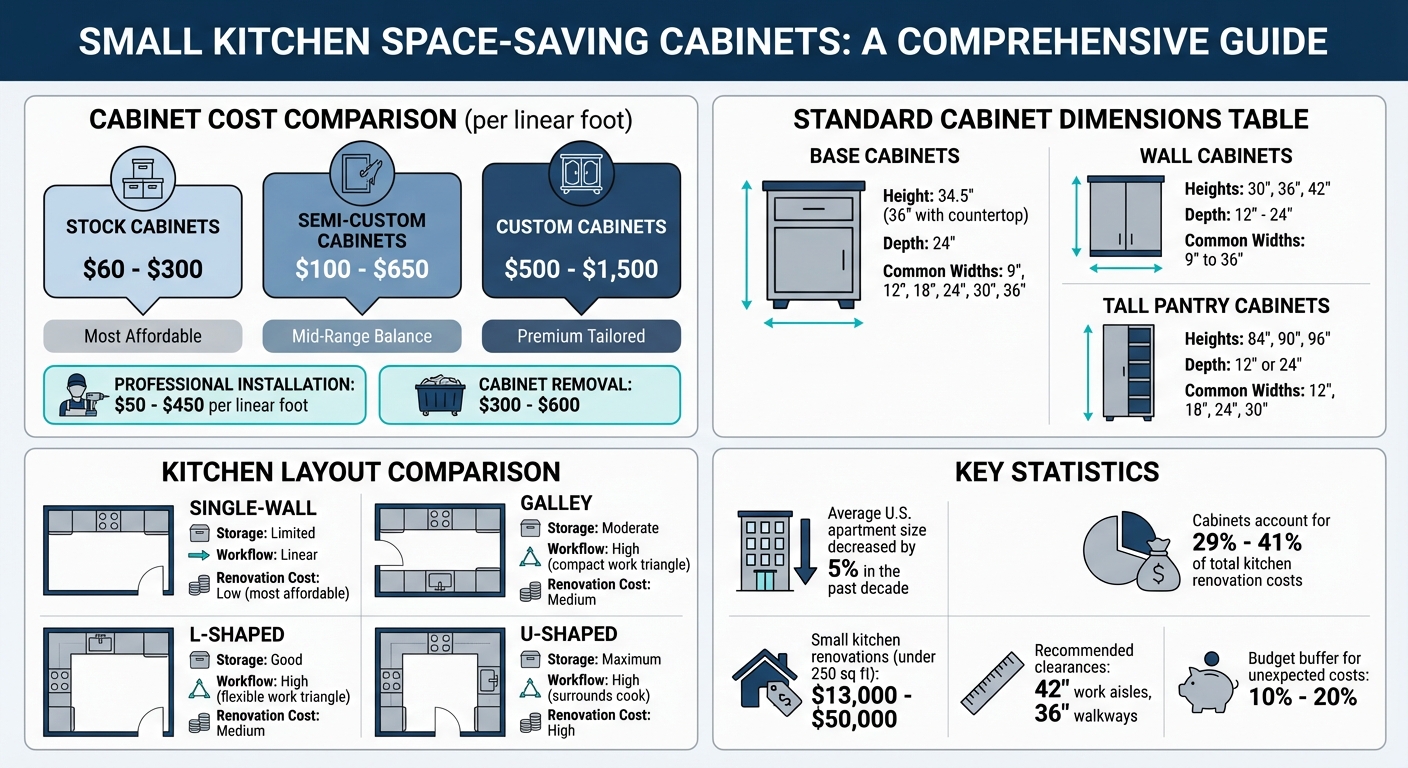
Small Kitchen Cabinet Costs and Standard Dimensions Guide
How Can I MAXIMIZE My Small Kitchen?
sbb-itb-8935015
Core Design Principles for Space-Saving Cabinets
When it comes to designing space-saving cabinets, three key principles take center stage: making the most of vertical space, opting for sleek and efficient styles, and sticking to standard dimensions to cut down on wasted space, clutter, and awkward gaps.
Using Vertical Space Effectively
One of the simplest ways to maximize storage is to extend cabinets all the way to the ceiling. This approach eliminates the often-unused gap above standard 30-inch wall units and creates extra storage for items you don’t reach for every day, like seasonal dishes. Depending on your ceiling height - whether it’s 8, 9, or 10 feet - opt for 30-, 36-, or 42-inch wall cabinets, respectively. Tall pantry cabinets, which range from 84 to 96 inches in height, are another smart solution. They offer a slim footprint while providing ample storage for dry goods, cleaning supplies, or other essentials.
For more efficient organization, vertical dividers can make a big difference. They allow you to store things like baking sheets, cutting boards, and cooling racks upright, saving space and preventing piles of clutter. And for those hard-to-reach upper shelves, pull-down systems are a game-changer. They bring items down to eye level, so you don’t have to drag out a step stool every time you need something.
Selecting the Right Cabinet Styles
The style of your cabinets isn’t just about looks - it also impacts functionality. Frameless (or European-style) cabinets are a popular choice because they maximize interior space by eliminating the face frame found in traditional designs. This means wider drawers and deeper shelves. For base cabinets, pull-out drawers are especially user-friendly, allowing you to easily access items without awkward bending or digging around.
When it comes to aesthetics, simple slab or flat-panel doors are a smart pick. Their clean lines help reduce visual clutter, and lighter finishes - like whites or soft grays - reflect light to make the room feel brighter and more open. If you want to add a sense of depth without making the space feel closed off, consider glass-front upper cabinets. And for a subtle design trick, two-tone finishes - darker lower cabinets paired with lighter uppers - can draw the eye upward, giving the illusion of higher ceilings.
Standard Sizes and Custom Modifications
Cabinet dimensions play a crucial role in creating a functional space. Base cabinets are typically 34.5 inches tall (36 inches with a countertop) and 24 inches deep. They come in widths ranging from 9 to 48 inches, increasing in 3-inch increments. Wall cabinets are available in heights of 30, 36, or 42 inches, with depths between 12 and 24 inches. For compact kitchens, narrower options - like 9-, 12-, or 18-inch-wide units - are perfect for fitting into tight spots, such as gaps between appliances or beside windows.
| Cabinet Type | Standard Height | Standard Depth | Common Widths |
|---|---|---|---|
| Base | 34.5" | 24" | 9", 12", 18", 24", 30", 36" |
| Wall (Upper) | 30", 36", 42" | 12" – 24" | 9" to 36" |
| Tall (Pantry) | 84", 90", 96" | 12" or 24" | 12", 18", 24", 30" |
Custom modifications can make standard cabinets work in tricky layouts. For example, reducing the depth of base cabinets or adding pull-out spice racks as narrow as 9 inches can help you make the most of every inch. Tom Knotts, the owner of Adalay Cabinets & Interiors, highlights the importance of precision during installation:
Very few walls or floors are level, so it is very important to check the level of both. If the level of the base cabinets is not correct, it will affect the countertop installation.
Cabinet Types and Configurations for Small Spaces
Making the most of a compact kitchen requires smart cabinet choices that prioritize efficient design and storage.
Full-Height Pantry Cabinets and Pull-Out Units
Tall pantry cabinets are a great way to store dry goods, small appliances, and cleaning supplies without taking up valuable floor space. These floor-to-ceiling units typically come in heights of 84, 90, or 96 inches and are available in widths of 18 or 24 inches, with depths of 12 or 24 inches. Despite their narrow footprint, they provide ample storage capacity, making them ideal for small spaces.
Slim pull-out units, usually 9 to 12 inches wide, are perfect for utilizing those small gaps between appliances or at the ends of counters. They’re ideal for organizing items like spices, oils, or baking trays - keeping countertops clutter-free. Paul McManus, Owner and President of McManus Kitchen and Bath, highlights the importance of versatile drawer designs in kitchen layouts:
Drawer base cabinets may be the most useful and versatile type of cabinet in your kitchen. Yet sometimes they're overlooked or not included in a kitchen layout at all.
Next, let’s look at how to tackle tricky corner spaces.
Corner Storage Options
Corners can be tricky to use effectively, but with the right solutions, they can offer valuable storage. Lazy Susans are a popular choice, featuring rotating turntable shelves in full-circle, kidney, or D-shaped designs that make it easy to access items stored at the back of the cabinet. For blind corners - where one cabinet is partially hidden behind another - specialized pull-out systems like "Magic Corners" or "Lemans Units" use sliding mechanisms to bring hidden items into view.
Another option is corner drawers, which feature angled or slanted designs that make better use of 90-degree corners compared to traditional shelving. These corner solutions work well alongside other specialized cabinets to optimize storage in small kitchens.
Small Islands and Specialized Base Cabinets
A small island can provide extra prep space and storage without overwhelming a compact kitchen. Movable islands on wheels are especially practical - they can be rolled out of the way when more floor space is needed. Many also include built-in shelves or drawers to keep frequently used items within easy reach.
Specialized base cabinets can further enhance storage efficiency. Drawer base cabinets with full-extension slides make it easier to see and access items compared to standard door cabinets. For cookware, consider a 3-drawer unit (27–36 inches wide), while a 4-drawer unit (18–21 inches wide) is perfect for utensils and spices. Vertical dividers can also be added to store cutting boards and baking sheets upright. Additionally, false drawer fronts under sinks can be converted into tip-out trays, providing a convenient spot for sponges and scrubbers.
Storage Hardware and Interior Organizers
When it comes to maximizing kitchen space, the right hardware and interior organizers can make all the difference. Features like full-extension slides provide easy access to even the deepest cabinet corners, ensuring no space goes to waste. Standard roller slides can hold between 35–100 lbs, while heavy-duty ball-bearing slides handle up to 200 lbs. These details work hand-in-hand with smart cabinet design to create a more functional kitchen through professional remodeling.
Pull-Out Trash and Recycling Systems
Pull-out waste systems are a clever way to keep trash and recycling bins hidden yet accessible. Before installing one, it's a good idea to mark the bin's footprint on the cabinet floor to confirm it clears plumbing, hinges, and disposal lines. A single 35-quart bin typically fits a 12–14-inch cabinet opening, while dual 50-quart bins need at least 21 inches. Brands like Rev-A-Shelf and Knape & Vogt offer systems that can endure over 10,000 cycles with proper care. These systems are a practical addition to any kitchen, blending seamlessly with the overall goal of saving space. For homeowners seeking professional assistance, Orlando remodeling experts can help integrate these systems into a custom design.
Toe-Kick Drawers and Vertical Dividers
Toe-kick drawers transform the often-unused 4-inch space at the base of cabinets into storage for items like baking sheets, placemats, or even step stools. For taller items, vertical dividers are a game-changer, preventing the chaos of stacked trays and cutting boards. Jamie Gold, a Certified Kitchen Designer, shares:
I either put them [tray dividers] in the space above the oven if there are a lot of trays and baking sheets to house, or in a narrow base cabinet that pulls out.
These dividers are especially useful in narrow cabinets, typically 9–12 inches wide, offering a smart way to keep everything organized and accessible.
Drawer Systems and Appliance Garages
Drawer-in-drawer systems are another clever solution, doubling up storage for flatware and small tools. Meanwhile, appliance garages can help conceal larger appliances, clearing up valuable countertop space. Catherine Pulcine of CPI Interiors highlights the versatility of this approach:
You can also build out drawers for small appliances.
To keep everything in top shape, remember to clean slides monthly and apply silicone-based lubrication twice a year. These small maintenance steps ensure your hardware stays functional and smooth for years to come.
Layout Options for Small Kitchens
The layout of your kitchen plays a huge role in how efficient and accessible your cabinets will be. Single-wall kitchens, where all cabinets and appliances are placed along one wall, are a great fit for studio apartments or narrow spaces. That said, they do come with trade-offs, offering less storage and counter space than other layouts. On the other hand, galley kitchens feature two parallel walls, creating a compact work triangle that’s perfect for one cook. With these basics in mind, let’s dive into how different layouts pair with specific cabinet setups.
Matching Cabinets to Common Kitchen Layouts
The right layout can make small kitchens feel bigger by coordinating functional zones with accessible storage. L-shaped kitchens are a crowd favorite for small spaces, as they use two connected walls to form a flexible work triangle while leaving room for dining or socializing. They’re especially well-suited for open floor plans and don’t usually require extensive renovations. For those needing maximum storage, U-shaped kitchens are an excellent choice, surrounding you with cabinets on three sides and offering plenty of counter space. However, they can feel tight in narrower kitchens. According to Andrew Saladino from Kitchen Cabinet Kings, "Galley kitchens or one-wall kitchens are the most efficient layouts for small kitchens".
Maintaining Clearances and Creating Openness
To ensure a safe and smooth workflow, aim for at least 42 inches in work aisles and 36 inches for walkways. Leave 12 inches of space beside cooktops and 18 inches around sinks. For a more open feel, consider glass-front cabinet doors or open shelving. These options can visually push the walls back by 1–2 feet, making the kitchen feel larger. As Stephanie Pierce, Director of Designs and Trends at MasterBrand Cabinets, explains, "Open shelving makes items easier to access, and it can be efficient not having to open and close doors in small spaces".
Layout Comparison for Cabinet Efficiency
Here’s a quick breakdown of how each layout stacks up when it comes to storage, workflow, and renovation effort:
| Layout | Storage Capacity | Workflow Efficiency | Renovation Complexity |
|---|---|---|---|
| Single-Wall | Limited; relies on vertical space | Linear; lacks traditional triangle | Low; most affordable |
| Galley | Moderate; uses parallel walls | High; compact work triangle | Medium; can feel closed-in |
| L-Shaped | Good; utilizes corner space | High; flexible work triangle | Medium; great for open plans |
| U-Shaped | Maximum; three walls of cabinets | High; surrounds the cook | High; tricky corner cabinets |
For tighter spaces, single-wall or galley layouts work best. If you’re looking for more storage and better workflow, L-shaped or U-shaped designs are worth considering.
Design Elements That Maximize Space and Style
The right design choices can transform small kitchens, making them feel more spacious and organized. Cabinet styles like Shaker doors or flat-panel slabs are excellent for creating clean, uncluttered lines. As Ana Cummings, Founder of ANA Interiors, explains:
You cannot go wrong with a simple Shaker front–panel door and drawer front. It's akin to the builder's beige of paint.
Let’s dive into cabinet styles, finishes, and other elements that enhance both space and style.
Cabinet Styles and Finishes
Frameless European cabinets are a smart choice for maximizing interior space. By removing the face frame found in traditional designs, these cabinets provide larger openings and more usable storage. Opt for finishes like semi-gloss, lacquered, or brushed surfaces to reflect light, which can make the kitchen feel brighter and more open. Additionally, extending wall cabinets all the way to the ceiling not only boosts storage but also gives the illusion of a taller room.
Color and Hardware Choices
Thoughtful color and hardware selections can amplify the spaciousness created by efficient cabinet designs. Light neutral tones - such as white, pale gray, or soft yellow - are particularly effective at reflecting light and creating an airy atmosphere. Walker Woodworking highlights this benefit:
Lighter shades reflect light, making the space appear larger.
For added depth, consider a two-toned approach: darker lower cabinets paired with lighter upper ones. This contrast enhances the feeling of openness. Minimalist hardware, like push-to-open mechanisms or integrated edge pulls, reduces visual clutter. You can also match cabinet finishes to the wall color to create a seamless, uninterrupted look that visually expands the room.
Mixing Closed Cabinets with Open Storage
Combining closed cabinets with open shelving strikes a balance between practicality and aesthetics. Open shelves break up the monotony of solid cabinetry, offering a visual pause that makes the kitchen feel less confined. They’re perfect for storing everyday items like coffee mugs or spices, keeping essentials within easy reach during meal prep. Beissel Renovation emphasizes their dual benefits:
Open shelving is a practical and eye-catching way to add more storage room while also making your kitchen look more spacious.
To maintain a tidy appearance, use decorative baskets or matching canisters on open shelves for smaller items. This approach keeps things organized while adding a touch of style.
Planning, Budgeting, and Working with a Remodeler
Starting a cabinet renovation project? It all begins with thoughtful planning and a realistic budget. Getting accurate measurements and clear cost estimates can help you avoid expensive errors down the line.
How to Measure Your Kitchen
Measuring your kitchen correctly is step one for any cabinet project. Begin by sketching out your kitchen’s layout and jot down the horizontal wall lengths in inches, measuring from corner to corner. Next, measure vertical heights from the floor to the ceiling (or soffit) in at least three different places - walls and floors are rarely perfectly straight [34,45]. Be sure to mark features like radiators, pipes, vents, and electrical outlets on your sketch [34,44]. For key utilities, note the center points of your sink, stove, and dishwasher so your cabinets align properly [34,50].
Here’s a quick tip: use the 3-4-5 rule to check if your corners are square. Measure 3 feet along one wall and 4 feet along the adjacent wall; the diagonal between those points should measure exactly 5 feet. This simple trick can save you a lot of frustration during installation.
Getting these measurements right is critical for setting up a budget that works for your space.
Budgeting for Cabinets and Installation
Once you’ve nailed down your kitchen’s dimensions, you can start creating a budget that matches your needs. Cabinets are usually the biggest line item in a kitchen renovation, making up 29% to 41% of the total cost [48,49]. On average, they account for about 41% of your overall expenses.
For smaller kitchens (under 250 square feet), costs typically range from $13,000 to $50,000, depending on your choices. Here’s a breakdown of cabinet costs per linear foot:
- Stock cabinets: $60 to $300
- Semi-custom cabinets: $100 to $650
- Custom cabinets: $500 to $1,500 [48,49,10]
Professional installation adds another $50 to $450 per linear foot, while removing old cabinets can cost between $300 and $600. To avoid surprises, set aside 10%–20% of your budget for unexpected expenses.
Working with Gomez Contractors
After planning and budgeting, the next step is finding the right remodeler. Gomez Contractors is a trusted name for kitchen renovations in Orlando and Central Florida. They handle everything - from taking precise measurements and creating 3D renderings to installing cabinets and adding the finishing touches. As a family-owned business, they pride themselves on personalized service, clear communication, and firm timelines, all supported by advanced project management tools.
Whether you’re adding tall pantry cabinets, optimizing corner storage, or reimagining your entire kitchen, their licensed and insured team delivers quality craftsmanship tailored to your space and budget. Ready to get started? Visit Gomez Contractors to discuss your project and request a custom quote for your small kitchen renovation.
Conclusion
Small kitchens don't have to compromise on storage or style. By using vertical space with floor-to-ceiling cabinets, opting for drawers instead of deep shelves, and making the most of corners with smart hardware solutions, even the tightest spaces can become fully functional. As CabinetCorp wisely notes:
Small kitchens reward intentional choices. Vertical cabinetry, a pull-out pantry, accessible drawers, and integrated organizers deliver maximum daily impact.
The difference between a cramped, cluttered kitchen and a well-organized one boils down to thoughtful planning and precise measurements. Custom cabinetry can make every inch count, with features like toe-kick drawers and pull-out pantries. Adding light colors, reflective surfaces, and under-cabinet lighting can create the illusion of a larger space, making your kitchen feel open and inviting.
Of course, design is only part of the equation - the execution is just as important. Partnering with skilled professionals ensures your vision becomes reality without unnecessary setbacks. Gomez Contractors brings the expertise needed for seamless installations, from reconfiguring layouts to integrating appliances with cabinetry for a cohesive look. Based in Orlando and Central Florida, their family-owned team handles everything from precise measurements to custom cabinet installations, all while maintaining open communication and sticking to agreed timelines.
Choosing the right remodeling partner can transform your kitchen experience. Visit Gomez Contractors to get a custom quote tailored to your needs and style.
FAQs
How can I make the most of vertical space in a small kitchen?
To make the most of vertical space in a small kitchen, think about adding tall cabinets that reach up to the ceiling - usually between 36 and 42 inches high. For better organization, include pull-out pantry units or stackable shelves to ensure every inch is put to good use. Another option is to install wall-mounted shelves or storage near the ceiling to keep everyday items accessible without overcrowding your countertops. These ideas can help create a kitchen that's both practical and stylish, even when space is limited.
What’s the best way to choose cabinets that maximize storage in a small kitchen?
Maximizing a small kitchen starts with understanding your storage needs. Begin by decluttering - keep only the items you regularly use. This way, your cabinets can focus on storing the essentials. Choose light-colored finishes and simple cabinet door styles like Shaker or flat-panel designs to make the space feel more open. For functionality, go with deep, full-extension drawers that offer easy access and pull-out inserts for organizing spices, pans, and pantry staples. Adding low-profile handles can enhance a clean and streamlined look.
To make the most of limited space, think vertically. Install upper cabinets that extend to the ceiling to utilize every inch and store items you don’t need daily. For those tricky corners, opt for pull-out corner units or lazy Susans to turn them into usable storage. If you prefer a lighter, more open vibe, consider combining open shelving with traditional closed cabinets for a balanced aesthetic. These thoughtful strategies can help you design a kitchen that feels efficient and spacious despite its size.
What’s the price difference between stock, semi-custom, and custom kitchen cabinets?
The price of kitchen cabinets largely depends on how much customization you want. Stock cabinets are the least expensive because they’re mass-produced in standard sizes and designs. If you’re looking for something a bit more tailored, semi-custom cabinets offer more design options and flexibility at a mid-range price. For those who want cabinets built specifically to their kitchen’s dimensions and style, custom cabinets are the priciest option, providing a one-of-a-kind fit and look.
If you have a smaller kitchen, semi-custom or custom cabinets might be a smart choice to make the most of your space without overspending. Think about what matters most to you - whether it’s saving money, having personalized options, or prioritizing craftsmanship - when deciding which type of cabinets to go with.