
Full Home Remodel Timeline vs. Room-by-Room Approach
Full Home Remodel Timeline vs. Room-by-Room Approach
When deciding on a home renovation strategy, you have two main options: tackle the entire house at once or renovate one room at a time. Each approach has its own benefits and challenges. A full home remodel is faster, typically taking 4 to 12 months, but often requires you to temporarily move out. On the other hand, a room-by-room approach spreads costs over time and allows you to stay in your home, but it extends the overall timeline and may involve repeated disruptions.
Key Points:
- Full Remodel: Faster completion, cohesive design, but requires upfront costs and temporary relocation.
- Room-by-Room: Flexible budgeting and allows you to stay at home, but takes longer and may lead to design mismatches.
Quick Comparison:
| Feature | Full Home Remodel | Room-by-Room Approach |
|---|---|---|
| Duration | 4–12 months | Months to years |
| Disruptions | Intense but short-term | Lighter but recurring |
| Cost Structure | Upfront, single project | Spread out over time |
| Living Arrangements | Temporary relocation often needed | Can stay in your home |
| Design Consistency | Easier to achieve | Harder to maintain |
Your choice depends on your priorities - speed and design consistency favor a full remodel, while flexibility and staying in your home lean toward room-by-room. You can explore our work to see examples of both approaches in action.
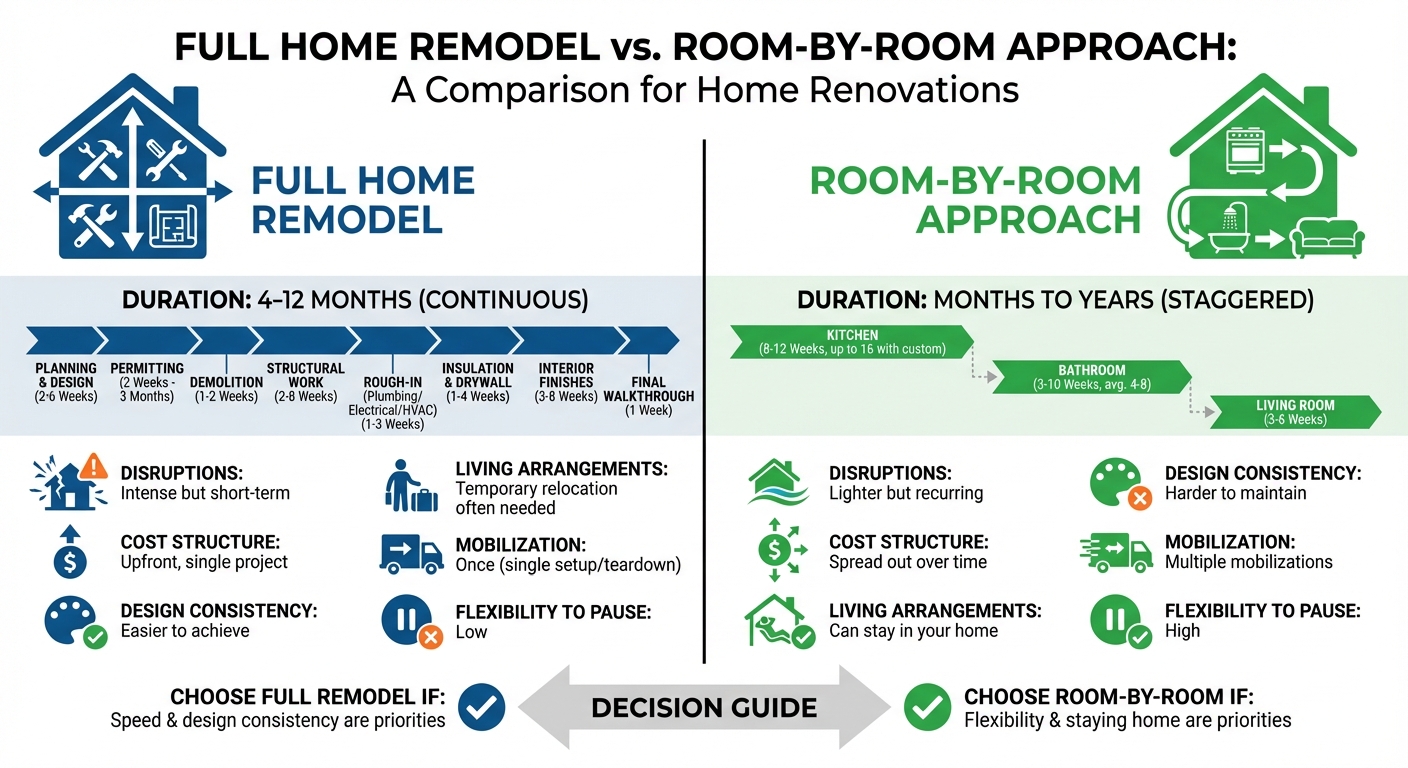
Full Home Remodel vs Room-by-Room Renovation Timeline Comparison
Full Home Remodel Timeline Overview
What is a Full Home Remodel?
A full home remodel involves renovating the entire house in one comprehensive project. This often means gutting the interior, replacing finishes, upgrading major systems like plumbing, electrical, and HVAC, and transforming the overall functionality of the space.
"A whole-house remodel is essentially building a new home inside your existing walls." – Ryan Norman, Founder, Norman Builders
Tackling the project all at once helps avoid repeated mobilization of work crews and ensures a consistent design throughout the home.
Typical Phases and Timelines
On average, a full home remodel takes anywhere from 4 to 8 months. However, if significant structural changes are involved, the timeline can stretch to 12–18 months. Here’s a breakdown of the key phases:
- Planning and Design: This phase takes about 2–6 weeks to finalize floor plans, choose materials, and set a budget.
- Permitting and Approvals: Depending on local government processes, permits can take 2 weeks to 3 months to secure.
- Demolition: Clearing out old materials typically requires 1–2 weeks.
- Structural Work and Framing: Adjustments like modifying load-bearing walls or adding new spaces can take 2–8 weeks.
- Rough-In Phase: Installing plumbing, electrical, and HVAC systems usually takes 1–3 weeks.
- Insulation and Drywall: Completing the structural enclosure takes about 1–4 weeks.
- Interior Finishes: Updates like flooring, cabinetry, countertops, and painting take 3–8 weeks to complete.
- Final Walkthrough: Wrapping up punch-list items takes roughly 1 week.
How Gomez Contractors Manages Full Home Remodels

Gomez Contractors streamlines full home remodels by combining design, permitting, and construction into a seamless workflow. Operating in Orlando and Central Florida, they use a design-build approach to minimize delays caused by splitting responsibilities between separate teams.
One of their key strategies is early material selection. By finalizing choices for cabinetry, tile, flooring, and fixtures during the design phase, they lock in lead times and avoid delays caused by backorders.
"Making all the material selections up front is a game changer when it comes to project timelines." – YNK Construction
Clients also benefit from digital project tracking tools, which offer real-time updates on schedules, photos, and milestones. Regular check-ins and a dedicated project manager ensure any issues are addressed quickly. To account for unexpected challenges like severe weather or hidden structural problems, they include a 10–20% time buffer in their project plans.
sbb-itb-8935015
Room-by-Room Remodel Timeline Overview
What is a Room-by-Room Remodel?
A room-by-room remodel focuses on renovating one area of your home at a time, rather than tackling the entire house all at once. This method is especially appealing for homeowners who want to remain in their home during the process and prefer to spread out the costs over time. While this approach does mean you'll have construction happening over a longer period, the disruptions are less intense compared to a full-scale remodel. It’s a flexible way to align renovations with your budget and daily life without overhauling everything at once.
Timeline Examples for Individual Rooms
Renovating individual rooms tends to be quicker than a full home remodel. Here's a general idea of how long each type of project might take:
- Kitchen renovations: These typically require 8 to 12 weeks of construction. However, if your project involves structural changes or custom elements, the timeline can stretch to 16 weeks.
- Bathroom remodels: Smaller bathroom updates can be completed in as little as 3 weeks, while more extensive projects, like master bathrooms, may take up to 10 weeks. On average, most bathroom remodels fall within the 4 to 8-week range.
- Living room updates: Depending on the scope, such as simple cosmetic changes or adding custom features, these projects usually take 3 to 6 weeks.
Phased Scheduling with Gomez Contractors
Gomez Contractors specializes in creating phased remodeling plans for homeowners in Central Florida, ensuring room-by-room projects are handled efficiently. They often start with high-impact areas like kitchens and bathrooms, addressing the most disruptive work early while energy and budgets are still strong. By carefully planning for materials with long lead times, they make sure everything is ready when needed. To keep your daily life running smoothly, they also set up temporary facilities and use containment measures to limit disruptions. Their organized approach ensures a smoother experience compared to tackling an entire home remodel all at once.
Timeline Comparison: Full Home Remodel vs. Room-by-Room
Differences in Project Duration
A full home remodel tackles all construction tasks within a single, continuous timeline, typically spanning 3 to 12 months. For a 2,500-square-foot home, this often translates to 16 to 24 weeks of focused work. This approach allows contractors to streamline tasks, minimizing delays caused by repeated setups and mobilizations.
On the other hand, a room-by-room renovation stretches the timeline significantly, often taking months or even years due to the sequential nature of the projects. While individual rooms can be completed relatively quickly - bathrooms usually take 3 to 12 weeks, and kitchens range from 8 to 16 weeks - the overall timeline grows as you repeat processes like permitting, ordering materials, inspections, and mobilization for each space.
"A whole home remodel wraps everything up more quickly, allowing you to settle into your finished home sooner. Meanwhile, taking it room-by-room means constantly adjusting as each project nears completion." – Timberline Renovations
Impact on Daily Life and Disruptions
A full home remodel compresses all disruptions into one intense period. This means dealing with constant noise, dust, and an overall lack of privacy for a short time. Often, the home becomes uninhabitable during this phase, as essential systems like kitchens, bathrooms, and HVAC may be out of service simultaneously.
"While the project may take longer and require you to vacate your home, you'll only need to deal with the disruption once rather than enduring multiple renovation phases over the years." – Munz Construction
In contrast, a room-by-room approach spreads out these disruptions over a longer period, allowing you to stay in your home. While the disturbances are generally lighter - such as keeping one bathroom functional while another is being renovated or setting up a temporary kitchen - they are recurring. Each new phase brings another round of demolition, construction, and cleanup, creating a prolonged sense of living in a construction zone.
Comparison Table
| Feature | Full Home Remodel | Room-by-Room Approach |
|---|---|---|
| Total Duration | 3–12 months (Continuous) | Months to Years (Staggered) |
| Active Construction | Concentrated, high-intensity | Staggered, less intense |
| Frequency of Mobilization | Once (Single setup/teardown) | Multiple mobilizations |
| Scheduling Complexity | High (Requires master coordination) | Moderate (Flexible to pause/start) |
| Flexibility to Pause | Low (Difficult once gutted) | High (Can wait between rooms) |
Factors That Affect Your Remodeling Schedule
Several key elements shape the timeline of your remodeling project. By understanding these variables, you can plan more effectively and make decisions that align with both your schedule and your budget. Let’s break down the most important factors.
Scope and Complexity of the Project
The extent of your renovation plays a huge role in determining how long it will take. For example, simple cosmetic updates - like painting, installing new flooring, or replacing fixtures - can be completed in as little as 3 days or stretch up to 3 months, depending on the size of the project. On the other hand, more extensive renovations, such as gut remodels that involve structural changes, foundation work, or moving walls, can take anywhere from 6 to 18 months.
If your project involves hidden systems like plumbing or electrical, be prepared for potential surprises. Issues like mold or outdated wiring can add an extra 1 to 1.5 months to the timeline.
"The more you touch, the longer it takes" – YNK Construction
Older homes, especially those over 40 years old, often present hidden challenges. It’s a good idea to build in an additional buffer of 1 to 1.5 months to address these surprises. Additionally, if your project includes custom materials like specialty tiles or imported fixtures, you’ll want to finalize those selections 2 to 4 months in advance to avoid delays caused by long lead times.
Living Arrangements During the Remodel
Your decision to stay in your home or temporarily relocate during the remodel can significantly impact the timeline. If you choose to remain in your home, safety protocols and daily cleanup requirements can slow down progress. This is especially challenging for families with young children who may find it harder to adjust to the disruptions.
Budget and Funding Considerations
Your budget not only determines what you can afford but also influences how you approach the timeline. A full home remodel typically requires significant upfront funding, which can extend the pre-construction phase by 5 to 8 weeks as you finalize plans and secure necessary permits. Alternatively, a room-by-room approach spreads costs over time but may lead to extra mobilization and permit fees along the way.
It’s also wise to set aside 10% to 20% of your total budget for unexpected issues that might arise during construction. Keep in mind that reputable contractors often require an initial deposit of around 15% at the time of signing the contract.
Choosing the Right Timeline Strategy for Your Home
Factors to Consider When Choosing
When deciding on the best remodeling strategy for your home, it's important to weigh your priorities. A full remodel is ideal if you want the project completed quickly and can temporarily relocate. On the other hand, a room-by-room approach is better suited for those who need to stay in their home during the process and prefer to spread out costs.
Summary of Timeline Strategies
| Your Priority | Best Approach | Key Benefit | Trade-Off |
|---|---|---|---|
| Fastest completion | Full home remodel | Faster timeline (4–12 months total) | Requires temporary relocation |
| Budget flexibility | Room-by-room | Costs spread out over time | Higher overall cost due to inflation and fees |
| Remain at home | Room-by-room | Access to functional spaces | Prolonged disruption (may take years) |
| Design consistency | Full home remodel | Unified look throughout the home | Significant upfront financial commitment |
| Price stability | Full home remodel | Avoids future cost increases | Less flexibility to make changes mid-project |
Whether you choose a full remodel or a room-by-room approach, Gomez Contractors can adapt their services to match your specific goals, ensuring the process aligns with your vision.
FAQs
What should I consider when deciding between a full home remodel and remodeling one room at a time?
When deciding between a full home remodel or tackling one room at a time, several factors come into play - budget, timeline, and how much disruption you're prepared to handle. A full remodel typically demands a larger upfront investment, but it can save money in the long run with bulk material purchases and contractor discounts. In contrast, remodeling room-by-room spreads costs out over time, though fluctuating prices for materials and labor might drive up the overall expense.
What impact does staying in your home during a room-by-room remodel have on the timeline?
Living in your home during a room-by-room remodel can stretch out the project timeline. Contractors have to navigate around your daily activities, safeguard your belongings, and keep essential areas of the house functional - all of which can slow down progress. Things like cleaning up after each workday, managing noise levels, and sticking to specific working hours can also add extra layers of complexity.
What challenges might come up when remodeling an older home?
Renovating older homes often comes with unexpected surprises that can impact both your budget and timeline. Common issues include structural concerns like foundation cracks, outdated electrical systems, aging plumbing, or hidden water damage that only comes to light when walls are opened up. Addressing these problems often means extra repairs or updates to ensure the home complies with current building codes.